| Subject: AU: Oil comes between helpful
neighbours (Shakedown review)
The Australian
January 26, 2008
Oil comes between helpful neighbours
Tim Johnston
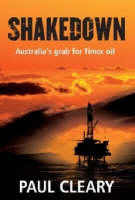
Shakedown
By Paul Cleary
Allen & Unwin, 304pp, $29.95
THE exercise of power is rarely a pretty thing to watch; but there is
something particularly ugly in watching the inept exercise of power.
Australia's engagement with East Timor during the past 70 years has
been a bewildering mixture of crude realpolitik and enlightened
assistance. The jury is still out on whether the latter has outweighed the
former.
In Shakedown, Paul Cleary has shone a light into one of the less
salubrious episodes: Australia's bullying attempts to get the Timorese
government to agree to a highly disadvantageous delineation of its
maritime borders in the resource-rich Timor Sea.
The book begins shortly after the 1975 Indonesian invasion with the
unedifying spectacle of Indonesia and Australia, both bereft of any moral
or legal rights, carving up the birthright of the East Timorese.
The prizes were the offshore oil fields in the Timor Sea. In return for
Australia recognising Indonesia's Anschluss in East Timor, and presumably
not making too much of a fuss about the tens of thousands of people who
were being slaughtered, Australia would get a highly beneficial maritime
boundary.
Canberra's cynical flight from principle -- and one must remember that
the people it was abandoning were the same people who protected Australian
Diggers during World War II at terrible cost to themselves -- might have
won some perverse justification had it brought substantial benefit to
Australia, but it didn't. By the time events forced the Indonesians to
withdraw 24 years later, in 1999, the two sides had benefited to the tune
of just $4.5million each from their carve up of East Timor. And as Timor
emerged blinking into the light after the long dark night of the
Indonesian occupation, Canberra saw its chance to rectify the shortcomings
of the past and tried a brazen land grab in the hope that the young
nation, inexperienced and still grateful for the Australian intervention,
would roll over.
That was a miscalculation.
Cleary was a participant in the epic David and Goliath battle that
ensued as the Timorese struggled to persuade John Howard, Alexander Downer
and the Department of Foreign Affairs and Trade that they hadn't fought so
hard and so long merely to donate their sovereignty to another predator.
He worked as a consultant to the Timorese government and witnessed many of
the incidents he describes.
It is a complex story, and sometimes Cleary loses his readers in the
byways of the negotiations, but the adrenalin of the high-stakes
brinkmanship carries the book through.
Australia initially wanted the Timorese to agree to the same sort of
compromised deal Canberra had negotiated with Jakarta, but it was
gradually forced back.
While Cleary is excellent on the Timorese side of the argument and on
the negotiations, it is still slightly unclear why Canberra droveitself
down this road to public relations disaster. Sheer greed, or even the joy
of exercising power for its own sake, seem inadequate reasons.
Dili's tenacious defence of the principles of sovereignty may have been
one reason the infant nation was able to withstand the pressure, but
Cleary shows that probably woudn't have been enough on its own. He also
gives due prominence to the role played in the result by ordinary
Australians who, appalled by Canberra's bullying tactics, put pressure on
the politicians to force them to give their new neighbour a fair go.
There will possibly be too much detail in parts of this book for the
casual reader, but the story of the diplomatic struggle is compelling, and
probably required reading for any serious student of the ugly reality
behind the elegantly turned phrases of diplomatic negotiation.
In some ways Shakedown is a morality play: a parable of how a small,
inexperienced nation with few powerful friends could take on a regional
heavyweight and its ruthless pursuit of resources. But if the Timorese
gained a victory, it was only partial.
Cleary does not baulk at pointing out the problems of corruption and
political ineptitude that were beginning to plague the government but he
is convincing in his argument that the Timorese position regarding its
maritime borders was fuelled by principle rather than the greed and
mendacity attributed to Dili at different times by the Australian side.
That does not mean Timor is free from greed or mendacity. Cleary ends
with a chapter on Timor's present troubles and warns that the country is
still far from safe from the explosive pressures of its own disappointed
citizens.
Good fences may make good neighbours, but that doesn't help much if
there is strife inside the house.
Tim Johnston has reported extensively from Southeast and Central Asia.
Back to January menu
December 2007
World Leaders Contact List
Main Postings Menu
|