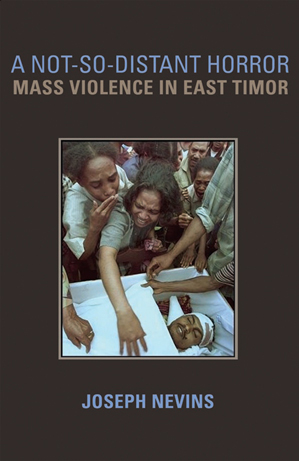
| Subject: review of A Not-So-Distant Horror
[copies available via ETAN, see http://etan.org/resource/booksetc.htm]
A Not-So-Distant Horror: Mass Violence in East Timor Reviewed by Jim
Glassman
Volume 96, Issue 4, Page 843, Cover Date December 2006
Journal Name: Annals of the Association of American Geographers
A Not-So-Distant Horror: Mass Violence in East Timor. Joseph Nevins.
Ithaca, NY: Cornell University Press, 2005. xx and 273 pp., maps, photos,
notes, and index. $49.95 cloth (ISBN 0-8014-4306-7); $18.95 paper (ISBN
0-8014- 8984-9).
Reviewed by Jim Glassman, Department of Geography, University of
British Columbia, Vancouver, British Columbia, Canada.
It is unlikely that there is anyone in the field of geography, or, for
that matter, the social sciences more generally, who is better positioned
to write this book than Joseph Nevins. Nor is there anyone who can more
legitimately ask the difficult questions that the book raises
specifically, questions regarding the moral responsibility of people in
the West for the destruction of life in East Timor. Writing for years
under the pseudonym of Matthew Jardine, Nevins traveled back and forth
between East Timor and the United States, supporting the struggle for East
Timorese independence by bringing information about the plight of Timorese
to audiences in the country whose government so decisively backed and
supplied the Indonesian occupation.
Building on both the information he gathered through this process and
the broader scholarly and journalistic literature, Nevins pieces together
an account of East Timor’s occupation, resistance struggle, and
liberation, sparing the reader none of the terror that accompanied the
final stages of the struggle for independence in 1999. Indeed, A
Not-So-Distant Horror refuses to abstract from the human suffering that
drew global attention to East Timor in that year, starting not with
scholarly chronological sequencing of the events that led to Indonesian
occupation but with the author’s trip to East Timor’s ground zero’’
(the razed capital city of Dili) two months after the post-September 1999
referendum violence.
Only after this does Nevins reconstruct an account of what happened and
how, and even then the purpose of the narrative is not so much to recount
events but to construct a geography of moral responsibility that is
mobilized by the jolt one receives from the scenery at ground zero.
In all of this, Nevins clearly means to provoke. How, he asks, can
Americans be so sensitized to the destruction of ground zero in New York,
the devastating consequences of the attacks of 11 September 2001, yet so
oblivious to a ground zero where an equal number of humans perished, only
in this case from arms and training originally supplied by governments
like the United States? With this question as backdrop, Nevins’s book
aims to sensitize.
After taking us to ground zero, Nevins looks at how East Timor got to
that point, examining the development of independence struggles under
Indonesian occupation (chapter 2), the maneuverings of the major
international actors that backed Indonesia (chapter 3), and the run-up to
and staging of the referendum on independence, with its tragic aftermath
(chapters 4 and 5). Having laid out historically the development of East
Timor’s ground zero, Nevins then turns in the remaining chapters to
questions regarding the role of the international community in East Timor
(chapter 6) and the degree to which various actors responsible for
Timorese suffering will (or won’t) be held accountable (chapters 79).
Nevins deals early in the book with theoretical issues that ground
notions of international responsibility, including conceptions of state
sovereignty and its erosion through various transnational processes. This
links Nevins’s account to arguments like those of John Agnew, who has
insisted on the ‘‘territorially trapped’’ character of social
science research that takes the national context as a watertight
container. As Nevins puts it, ‘‘territorially trapped’’ accounts
‘‘typically do not give adequate weight to the role of social actors
and institutions outside the countries directly involved in an interstate
conflict in facilitating, and aiding and abetting or allowing it to unfold
or both’’ (p. 17).
But Nevins’s purpose in invoking this literature is not to unpack
theoretical issues in critical geopolitics; rather, it is to lay the
foundations for his claims about international moral responsibility and
the importance of collective memories of violence (e.g., pp. 2021).
Toward this end, Nevins does an especially effective job of foregrounding
the callousness and complicity of various U.S. power-brokers. Paul
Wolfowitz (today known for his role as George W. Bush’s Undersecretary
of Defense, in promoting the current U.S. war in Iraq) is shown to have
played an instrumental role, as Reagan’s Ambassador to Indonesia in the
1980s, in selling the Indonesian occupation of East Timor to the U.S.
Congress (pp. 4547). Indeed, even as late as 1999, Wolfowitz was
insistent that ‘‘independence for East Timor was simply not a
realistic option’’ (p. 115). It is not merely Reagan-Bush officials
who are culpable in their unstinting support for Indonesian occupation,
however. As Nevins points out, the Clinton administration continued
supplying Indonesia with military and economic assistance right through
the 1990s, and Clinton comes off as snide and dismissive in his response
to questions about this from journalist Alan Nairn (pp. 13940). In fact,
it was not until very late in the day that the Clinton administration
began to challenge Indonesia’s referendum violence (pp. 124125).
Moreover, it is not only U.S. officials who have feigned innocence and/or
denied culpability, as Nevins shows through his examination of the
responses of Australian officials to claims about their own considerable
culpability -- Australia having played a major role in backing Indonesia’s
occupation from the 1970s up until the post-referendum period (pp.
14748).
All of this, in many respects, makes for a very compelling case. Nevins
is on target in assigning moral responsibility to those who backed Jakarta’s
violence. Moreover, he is not simply constructing a high-minded moral
accounting system but is concerned about the consequences of our
understanding of the East Timor situation for concrete projects of justice
specifically, the holding of parties who authored violence responsible and
the payment of reparations to East Timor. It is only if our historical
memory of the violence in East Timor allows us to see the differing forms
of international complicity, he contends, that we can adequately make the
case for agendas such as an international human rights tribunals or
reparations from countries that backed the violence.
Here, however, it seems to me that if the moral case is compelling,
Nevins’s analytical account becomes slightly less so. In fact, one of
the rather vexing pieces of the East Timor justice puzzle has been that
the current Timorese leadership shows no commitment to demands for either
an international human rights tribunal or a serious program of
reparations, much to the frustration of international backers of the
Timorese independence struggle. Nevins notes this phenomenon in passing
(pp. 15354), and certainly it reflects to a great extent the harsh
realities of global power politics. Timorese leaders have some reason to
feel that they can realistically expect little from the international
community (particularly the U.S. government), and what little they can get
is likely to be conditioned on forms of ‘‘good behavior such as
forgoing charges against Indonesian military officials or demanding
reparations from the United States and Australia. Yet this suggests that
such power relations are precisely in need of analysis if we are to
understand not only how East Timor has gotten to where it is today but
where it is likely to go in the near future. The moral claims that
Timorese can make against various groups directly or indirectly
responsible for their suffering are compelling; the likelihood of those
claims resulting in the international community redressing Timorese
suffering to any great extent is at best questionable.
To no small extent, moreover, the unlikelihood of holding authors of
violence responsible or of obtaining significant reparations may have to
do not only with the raw power equation of international relations but
with the evolving class interests of the new Timorese leadership itself.
An analysis of such interests, which Nevins doesn’t undertake, might
help us better understand how Clinton was able to shrug off his own
responsibility for violence with the following claim, in response to Nairn:
I think the right thing to do is to do what the leaders of East Timor
said. They want to look forward, and you want to look backward. I’m
going to stick with the leaders’’ (p. 140). This claim, however
opportunistic, in fact dovetails with Timorese Foreign Minister Jose
Ramos- Horta’s assertion that ‘‘We shouldn’t just look to the
past.We need to look at the good relations we have with the U.S. in 2001,
not our relationship in 1975’’ (p. 153). It also dovetails with
Timorese President Xanana Gusmao’s characterization of the Indonesian
occupation as the result of a historical mistake which now belongs to
history and to the past’’ (p. 154). If the Timorese leadership is
itself abandoning the project of social justice for which Nevins so
convincingly speaks, perhaps it would be useful to know more about why
this is the case.
That having been said, A Not-So-Distant Horror is a very worthwhile
book. If it does not fully chart the geopolitical and economic terrain on
which Timorese reconstruction is occurring, it nonetheless charts the
terrain of a transnational moral geography that can inform struggles over
social justice.
Back to December menu
November
World Leaders Contact List
Main Postings Menu
|