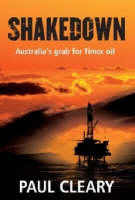
| Subject: FEER Books: Shakedown: Australia's
Grab for Timor Oil
Far Eastern Economic Review
November 2007
Book Reviews
Shakedown: Australia's Grab for Timor Oil by Paul Cleary Allen &
Unwin Academic, 336 pages, $19.95
Reviewed by Jeff Kingston
In late 2006 while walking home one starry night, stupidly ignoring
warnings about the dangers on Dili's streets after dark, I was accosted by
several youths who asked in menacing tones if I was Australian. I set them
straight and they let me pass, making me wonder just how many places in
the world these days it is better to be an American than from Down Under….not
many I suppose.
So how did things go so wrong for Australia, erstwhile savior of East
Timor? After all, Australian troops were the first to arrive after the
Indonesian military and their militia thugs laid waste to Dili in
1999-just after the courageous vote for independence by U.N.-administered
referendum. Since then, Australia has been at the forefront of nations
seeking to rebuild East Timor with generous assistance and the commitment
of much needed security personnel. Paul Cleary helps us understand why a
nation that has given so much inspires more resentment than gratitude. The
Australian government's checkered record on East Timor-a case of greed
trumping principle-causes many Timorese (and Australians) to feel an acute
sense of betrayal.
Certainly this sordid chapter in Australian diplomacy is one that
Canberra's diplomats will rue, but it should be required reading for new
recruits so that they can learn the folly of arrogance, duplicity and
hypocrisy. East Timor, the first nation born in the 21st century, is one
of the poorest nations in the world and has been plagued by a host of
problems as it emerges from 24 years of brutal Indonesian occupation from
1975-1999. Mr. Cleary makes a compelling case that Australia, its wealthy
and powerful neighbor, has much to answer for by trying to plunder Timor's
oil and gas resources and deny this impoverished nation its rightful
revenues.
Bullying Australian diplomats were determined to seal a deal that would
leave East Timor destitute and dependent on external assistance. The
resource curse-the sudden gushing of revenues that get squandered or
pocketed-has long plagued developing nations and many have little to show
for their windfall. Perhaps Team Australia was trying to help East Timor
solve the paradox of plenty by robbing them of their resources.
Shakedown details the extortionate tactics that Australian diplomats
deployed to deny East Timor its legal share of oil and gas resources in
the seabed of the Timor Sea that divides the two countries. Mr. Cleary
takes us back to the decision by Canberra to recognize Indonesian
sovereignty over East Timor back in 1978.
After Indonesian troops invaded in 1975, Richard Wolcott, then
ambassador to Indonesia, advised then Prime Minister Gough Whitlam that a
better deal for seabed resources could be struck with Indonesia than an
independent government, helping explain why Australia was the only Western
nation to recognize Indonesian sovereignty over East Timor. Canberra
managed to cut an extremely favorable deal with Jakarta, a shady quid pro
quo that did little to burnish Australian honor.
East Timor's leaders, however, made it clear early on in the
negotiations that began in 2001 that it was not going to allow Australia
to profit from this criminal deal with its former occupier. As an advisor
to the East Timor government, Mr. Cleary gives us an insider's account of
the negotiations, providing some lessons about maritime law and a tutorial
on cupidity. A former journalist, the Australian author does not let the
technical details overwhelm a contemporary David-versus-Goliath tale. He
sketches the personalities that shaped the negotiations and shares
fascinating anecdotes that breathe life into the "smoked-filled
rooms."
In 2005, after four years of acrimonious negotiations, a partial
agreement was struck on one of the large oil fields, Greater Sunrise, that
gave East Timor 50% of the revenues, the minimum Dili could accept and the
maximum Canberra could abide. Part of this creative agreement involved
postponing settlement of the maritime boundary in the Timor Gap for 50
years. Much credit for rescuing the negotiations goes to then Foreign
Minister and current President Jose Ramos-Horta, a Nobel laureate with
considerable diplomatic savvy and a far less abrasive style than then
Prime Minister Mari Alkatiri.
The villains in this unseemly tale constitute a who's who of Australian
politics. From Mr. Whitlam to John Howard, Australian leaders have been
unapologetic about their oil grab. Foreign ministers from Andrew Peacock
to Alexander Downer have also staunchly asserted the national interest to
cover the ignominy of official policy.
Mr. Downer proved both obdurate and puerile, issuing ultimatums,
slamming tables and threatening to prevent any exploitation of the
resources unless Australia got its way. He also cut funding to Timorese
NGOs that criticized Australia, undoubtedly a valuable civics lesson. In
order to protect against arbitration that would most likely favor East
Timor's claims, the Howard government also withdrew from dispute
settlement procedures under the International Tribunal for the Law of the
Sea and rescinded recognition of the jurisdiction of the International
Court of Justice for maritime disputes.
Upon finishing this fine book the reader is left wondering why so many
of the best and brightest acted so dishonorably in support of a policy
that undermined the national interest by tarnishing Australia's moral
stature. What did they seek to "win" at the expense of a
desperately needy neighbor?
One of the prominent non-Australian actors who does not emerge
particularly well from this tale is Peter Galbraith, a renowned diplomat
and writer, who also happens to be the son of John Kenneth Galbraith, the
illustrious economist and presidential adviser. He is described as loud
and proud, abrasively American even to his fellow countrymen. Working out
of the United Nations on behalf of the East Timor team, Galbraith's
blustering ways antagonized the Australian negotiators, but imparted a
needed bravado to the inexperienced and outgunned Timorese. However, as
the discussions dragged on, he is portrayed as being overeager to accept a
buyout, pressuring the Timorese to accept a $3 billion cash settlement
that in retrospect would have been a very bad deal. By sticking to their
principles and standing up for their legal entitlements, the Timorese
ended up with a far more lucrative arrangement that enables them to share
in the upside of surging energy prices. So much for hotshot consultants.
Mr. Cleary also presents a mixed portrait of former Prime Minister Mr.
Alkatiri, a man he knows well from working closely together. In the
negotiations Mr. Alkatiri remained steadfast in refusing to cave in to the
threats and tactics of Team Australia. He was confident that international
law was on David's side and that ultimately this would force Goliath to
bend. His brinksmanship and resolute negotiating stance made him few fans
among the Australian officials and he remains convinced today that enemies
he made in standing up for East Timor's resource rights conspired against
him and engineered his downfall.
Mr. Alkatiri resigned in disgrace in June 2006 due to allegations about
his role in arming hit squads and for mishandling a crisis within the
military ranks. The military dissension morphed into looting, arson and
violence on the streets of Dili, displacing some 15% of the population,
many of whom still live in temporary shelters. Mr. Cleary suggests that
Australia is partly to blame for the unrest, but also takes Mr. Alkatiri
to task for his authoritarian tendencies and nepotism. His party, Fretilin,
did poorly in the 2007 elections, an outcome that Mr. Cleary seems to
anticipate. In the chapter entitled "Animal Farm," he describes
the formerly dominant party in Orwellian terms and gives it poor marks for
governance.
One of the more interesting angles in this story is the role of civil
society organizations in Australia and the improbable heroics of a
Melbourne-based optometry baron, Ian Melrose. He became engaged upon
seeing a program concerning the health problems of Timorese children and
outraged by his government's larcenous diplomacy. He funded an ad campaign
that aroused public opinion against official policy, appealing to the
deep-rooted sense of fair play among Aussies and shaming the government
for trying to fleece its poor neighbor. NGOs mounted a spirited campaign
and the media raised the heat on the Howard government, contributing in no
small part to the compromise settlement. The dignified Australian public
understood common decency even when their government could not.
Mr. Kingston is director of Asian studies at Temple University's Japan
campus.
------------------------------------------
Terjemahan (atas jasa "Kataku"): http://66.114.70.144/
------------------------------------------
Joyo Indonesia News Service
Back to November menu
October
World Leaders Contact List
Main Postings Menu
|